Is Your Workplace Actually Safe — Or Does It Just Look That Way on Paper?
Most small employers thought they were exempt from California's workplace violence law. They're not — and now they're scrambling, copying templates that won't hold up. This book shows you the difference between a compliance plan that protects you and one that just looks like it does — from someone who's spent 30 years investigating and building cases for plaintiff attorneys when violence occurred at a workplace, conducting internal investigations for employers, and evaluating for plaintiff attorneys whether employer investigations were substance or performance.
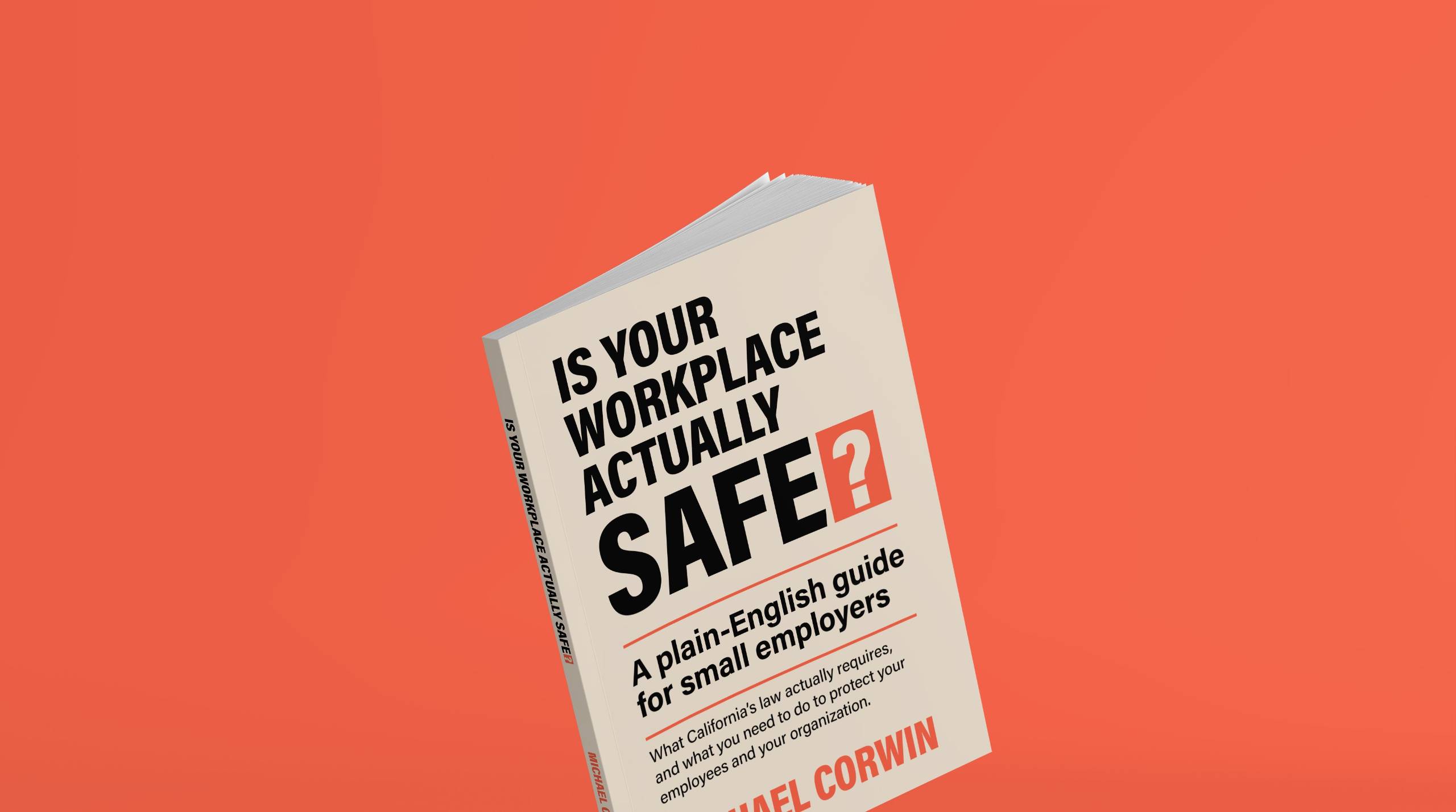
This book is only available here.
Looking compliant and being protected are two different things. Most small employers can't tell which one they have.
I can. I've spent over 30 years looking at the gap between the two, from the side that gets hired after something goes wrong and violence happened at a workplace. I've conducted roughly 12,000 witness interviews, and I've evaluated whether employers' investigations were a genuine search for the truth or a paper exercise. I've seen how an employer's small oversight looks blown up on an exhibit board in front of a jury.
You downloaded checklists. You patched something together in 2024. It looks like a plan. You don't know if it is one.
What this book gives you
- You thought your employee count made you exempt. It doesn't.
- What the law actually requires, explained in plain English — not legal code.
- Why the template you downloaded won't hold up if something happens.
- How to tell a compliance plan that's real from one that's just paper.
- You don't need a safety department to meaningfully reduce your risk.
Get Your Copy Today
This book is only available here.
Why you can trust what's in this book
- 30+ years investigating violent incidents at workplaces as the investigator plaintiff attorneys hired after something went wrong
- Roughly 12,000 witness interviews across litigation and internal workplace investigations
- Six years on contract investigating judicial misconduct for the New Mexico Judicial Standards Commission, with findings on removal cases argued before the New Mexico Supreme Court
- Safety hazard assessments, remediation, and training for law firms, court administrators and their staff, nonprofit organizations, and the statewide staff of a United States Senator
I'm not telling you this so you'll trust me. I'm telling you because I've seen the gap up close, from both sides.
Inside the book: each chapter closes a piece of the gap
1. You're Already a Target. Closes the gap in whether this applies to you. "We're too small" is the belief that leaves owners exposed.
2. The Law Doesn't Care How Many Employees. Closes the gap in who the law covers. It's about who can walk through your door.
3. When Workers' Comp Isn't the Ceiling. Closes the gap in what you're really liable for, including the penalty your insurance can't touch.
4. What a Real Investigation Looks Like — and What Doesn't. So you can tell if yours would survive one.
5. The Anatomy of a Defensible Investigation. Closes the gap between an investigation that exists and one that holds up when someone with a reason to look pulls it apart.
6. When the Plan on Paper Isn't Enough. Shows you where a plan that looks complete still fails.
7. The Compliance Plan, Piece by Piece. Closes the gap in what a real plan has to contain, every required element in plain English.
8. Do It Yourself — With Eyes Open. A real DIY path, and an honest look at where it breaks, so you know which side of the line you're on.
9. There's No Making Whole. Shows you what a failed hiring and supervision decision actually costs.
10. Your Options From Here. A short self-assessment that tells you what to do next.
Get Your Copy Today
This book is only available here.
What this book won't do
It won't hand you a fill-in-the-blank template. A template is the paper-compliant trap. It's exactly what plaintiff lawyers and regulators use to prove an employer never took the law seriously.
What it will do is show you what a real plan requires, so you can close the gap yourself, or know when you can't.
What getting it wrong can cost
- Cal/OSHA citations that stack. Each missing or deficient part of your plan can be cited as its own violation: up to $25,000 for each serious violation, and more than $160,000 for each willful or repeat violation. No plan is one citation. No hazard assessment is another. No training records, another. For a small business, two or three citations is enough to do real damage.
- A 50% cash penalty on top of a workers' comp claim, payable by you, that insurance can't cover. On an $80,000 benefit, that's another $40,000 out of your own pocket.
- Premises liability. When a customer, client, or patient is injured by another customer, client, or patient on your property, California verdicts and settlements are at least $250,000 and can reach $1,000,000 or more, depending on the severity of the injury.
This isn't hypothetical. In June 2026, Cal/OSHA proposed $273,200 in penalties against a San Francisco hospital and the university that helped run it, after a fatal attack on a staff member. That wasn't one fine. It was fifteen separate citations: missing hazard assessments, missing violent incident logs, an ineffective prevention plan, and failing to report the incident. Each missing piece was its own violation.
And there's a cost no number captures. Chapter 9 walks through what happened when an employer's hiring and supervision decisions failed, and what it cost.
Cal/OSHA citations that stack, one for each missing piece. A 50% penalty your insurance won't touch. A liability claim of at least $250,000, and up to $1,000,000 or more.
The book is $29 plus $9.99 shipping and handling.
You also get the ebook as a free bonus, so you can start reading today while your paperback ships.
Find out which one you actually have.
Please allow 10–14 days for delivery. Secure checkout.