A More Effective and Efficient Post-Incident Response
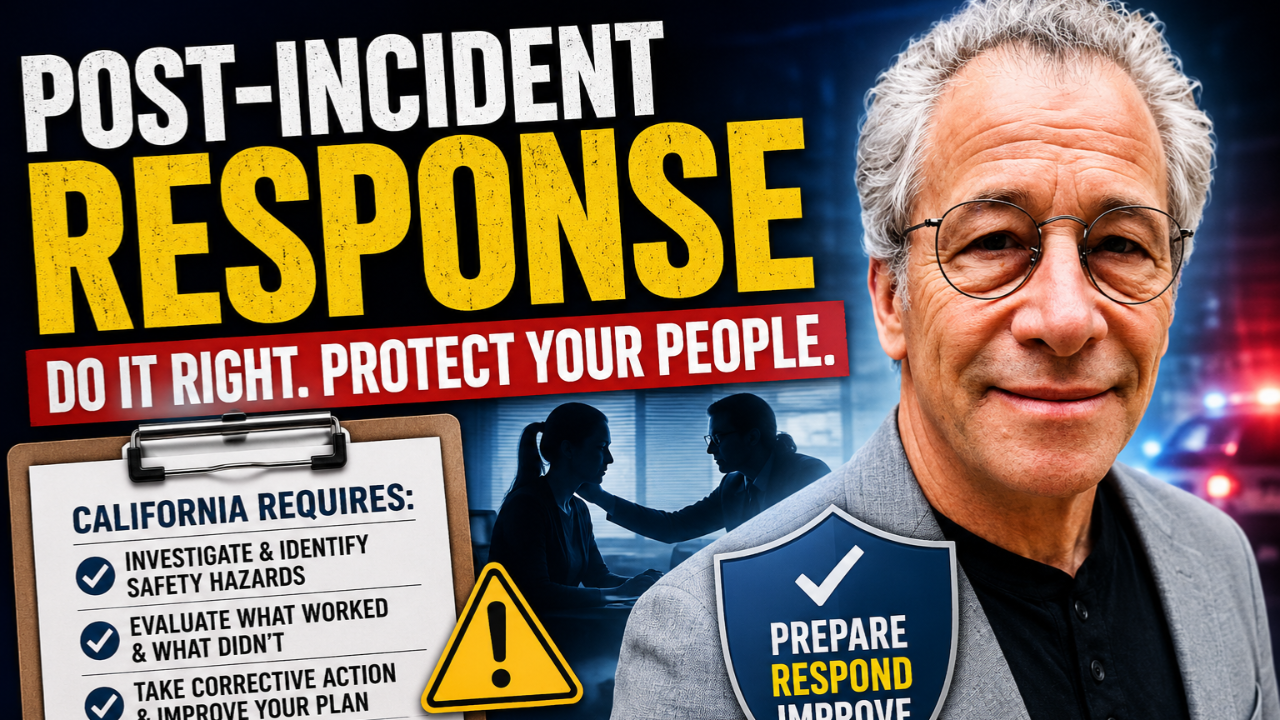
If you're a small California organization whose employees interact with the public, you are required to have an effective workplace violence prevention plan,
in this piece, we’ll look at creating a post-incident response, which California requires from employers when there’s a workplace violence incident. And we’ll focus on a simple; yet, effective way to get that done: through your state required investigation process.
I spent 30 years conducting investigations into violence. I conducted civil plaintiff investigations building cases against organizations where violence took place, high level internal investigations for businesses, nonprofits, and government agencies, and criminal defense investigations.
Through my work, I saw firsthand how violence occurs and learned how it can be prevented.
Over ten years ago, I took what I learned and started working with organizations helping them implement effective workplace violence prevention programs that kept employees safer and lowered regulatory, and liability risk.
Free 15‑Minute Compliance & Safety Snapshot (California Only)
If you’re a California employer with 5–30 employees and your team interacts with the public, you’re now required to have a workplace violence prevention plan that actually works in practice, not just on paper.
If you’d like a quick, no‑obligation snapshot of where you stand, you can book a free 15‑minute Workplace Violence Compliance & Safety Snapshot call here: [Get Your Free 15‑Minute Snapshot].
- Here's what California requires of employers post incident:
- Medical care to employees injured in an incident.
- Identifying all employees and other persons involved in the incident.
- Making trauma counseling available for any employees affected by an incident.
- Post incident debriefing.
- Identifying, and evaluating any workplace violence hazards that contributed to the incident.
- Identifying and evaluating whether appropriate corrective action taken initially during your workplace violence prevention plan was effective,
- Soliciting from employees involved in the incident, their observations, regarding the cause of the incident, and whether any measures could have prevented that incident.
Violence incident log.
Since medical care and trauma counseling are their own separate categories we’ll leave those to another post.
So let's focus on how you can use the investigation process, and in particular, your witness interview process, to make the rest of the required post-incident response more effective and efficient.
Post-incident Debriefing.
Traditionally, we think about debriefing, as getting everybody together collectively, and saying, hey guys, here's what's happened. Now give me your feedback.
But that's really not an efficient way to get the level of quality information you need to make this process really effective.
And because it adds an extra step, it uses time and resources that can be more economically used elsewhere. Plus, collectively people are reluctant to speak frankly.
A better, more efficient way to accomplish this required piece of your post-incident response is to use the witness interview process of your required internal investigation to debrief the incident.
And it’s very efficient since you have to interview every employee that witnessed or was targeted during the incident.
It can even help to mention during the interview that you’ll be using part of the interview to debrief the incident. So I’ll need you to take me through everything that happened.
So that we can figure out what led to the incident, and how we can prevent another incident from happening.
An effective debriefing is about identifying and evaluating the safety hazards that contributed to the incident. So witness interviews are the most efficient way to get that information.
Identifying Safety Hazards that Contributed to the Incident
Although we try to do so during the assessment process of creating a workplace violence prevention plan, we don't always have a read on what can lead to an incident until an incident actually occurs.
So using the witness interview process is a really good way to identifying safety hazards that we didn't previously anticipate.
And I'll give you a really good example of that.
Most people think that you can de-escalate an angry person in the workplace before a violent attack occurs. As a result, they’ve easily identified a safety hazard (angry person) and a strategy to deal with that safety (de-escalation). Just like that.
But that's really not the case.
Most violence occurs without warning. And you can't deescalate something if you don’t know it’s coming.
But, you can use the witness interview process to identify how a specific violence happened. What triggered it, and then identify types of interventions that could have been used before the attack, or baring that what types of trainings your employees need so that they are able to keep themselves safe when that type of safety hazard arises.
How Accurate and Effective Was Your Initial Plan?
Following an incident, California requires you to assess the effectiveness of your initial workplace violence prevention plan.
Conducting witness interviews while investigating an incident allows you to efficiently do so
You may have done a great assessment when you first created your plan. You may have identified all the right safety hazards. You may even have put in place, the best training for those safety hazards.
But stuff happens.
So this is a really good way of looking at what you initially put into place and assessing the effectiveness of that approach. Was it a good approach in theory, only to find it failed in practice.
And to use that information to decide if you need to approach things differently, including the type of training your employees get.
For example, if you provided training in de-escalation, but not on situational awareness. So going forward you can better prepare your people to recognize earlier that a situation is developing so that they can avoid the situation before it turns violent.
Assessing What Could Have Prevented the Incident
California requires you to assess an incident to determine better ways to prevent them. We’ve already discussed how witness interviews can help you identify safety hazards you might have missed, and whether your initial approach to violence prevention was effective.
You can also use the witness interview process to determine what types of measures would have prevented the incident from occurring, or to lessen the severity of an incident that does occur.
You can do that with the open ended question “is there anything that we could do differently that you think could have prevented this from happening?”
Then stop talking and let them talk. For as long as it takes.
Each of these required elements of your post-incident response can be addressed during your witness interview process, streamlining it, and making things much more efficient for you.
Now, there's one last way to use the witness interview process to create an effective and efficient post-incident response.
Violent Incident Log
California requires employers to maintain a violent incident log, and to document specific information when an incident occurs.
California wants you to develop this information from the investigation that you conduct, and if available from any police reports from the incident.
The purpose of the violent incident log is to identify all of the facts of an incident and use that data to figure out ways to improve your workplace violence prevention plan.
Workplace violence prevention is not a static process. You don’t prepare a plan and then shove it into a drawer. Instead you need to assess the effectiveness of your plan and then improve it each and every year, and after every incident.
With the violent incident log, you have a single place to put all of the data you develop so you can assess what changes you need to make. Information like:
- Who was involved.
- What took place.
- What types of violent incident sources were involved.
- Were weapons used.
- How did the incident develop.
- What types of safety hazards were behind the incident.
- What processes have we put in place to prevent it from happening again.
- Why didn't your existing processes not work?
Using your investigation process, and especially the witness interviews you conduct, is the best way to streamline and make your post-incident process effective as required by California law.
If you're ensure whether your workplace violence prevention plan complies with California law, is effective enough to keep your employees safe, and will help reduce your regulatory and risk exposure.
If you’re reading this because you’re responsible for safety or compliance in a small California organization, the fastest next step is a short, free 15‑minute snapshot call. We’ll pressure‑test how you’d look if a regulator or plaintiff’s attorney asked tomorrow, and flag your top risks.
[Get Your Free 15‑Minute Compliance Snapshot]
