
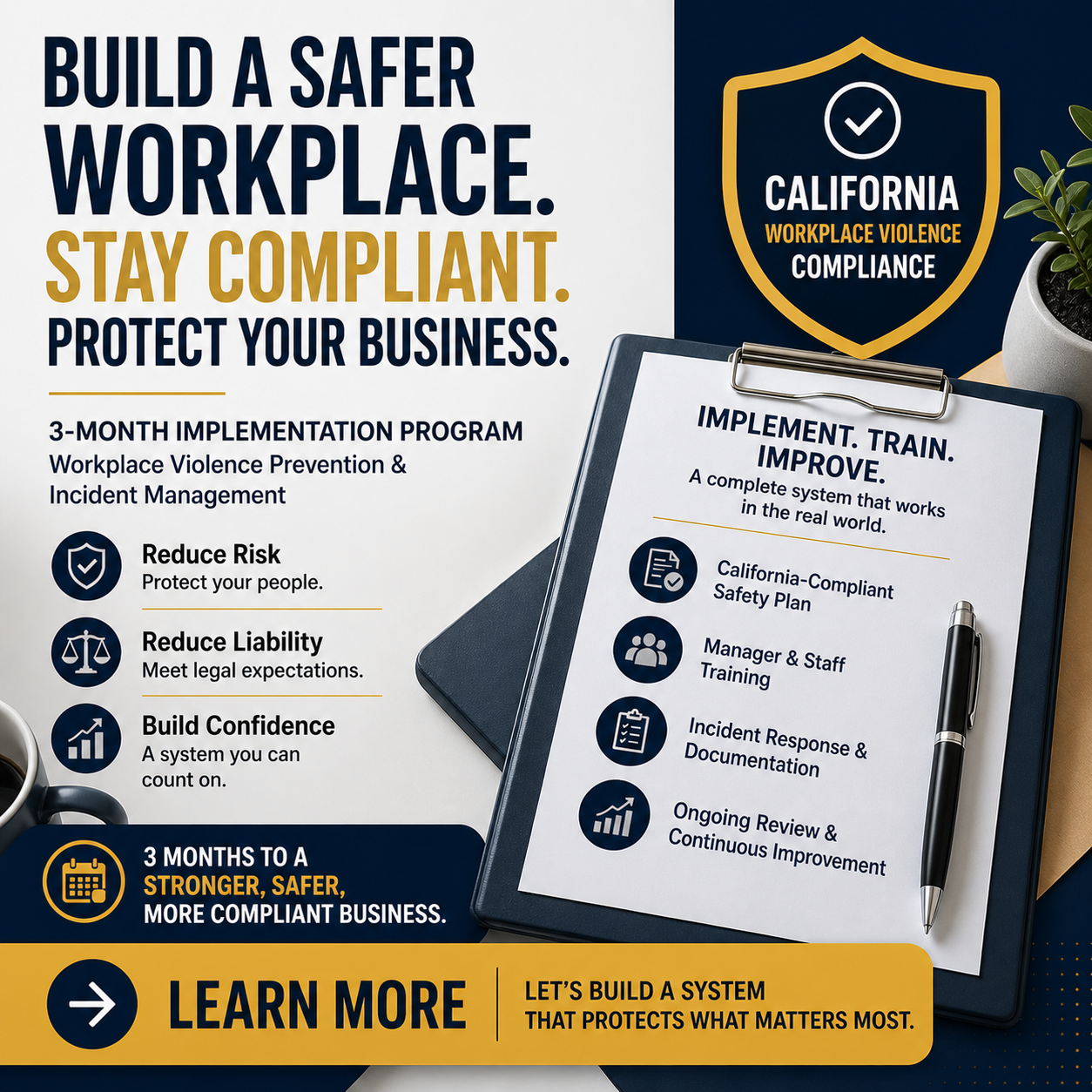






1. Align your plan with California workplace violence prevention requirements
So your written plan and day‑to‑day practices actually match what regulators and plaintiff attorneys expect of small employers, including:
- Real‑world risks from the public, clients, patients, vendors, and domestic‑violence spillover
- Clear roles and responsibilities for owners, managers, and staff
2. Train managers on incident response, documentation, and internal investigations
So your managers know:
- What to do and say when something happens
- What must be documented, by whom, and when
- How to conduct and document internal investigations in a way that looks reasonable and defensible if it’s ever reviewed by an outside investigator, regulator, or plaintiff’s attorney
3. Teach staff personal safety and de‑escalation skills suited to your environment
Tailored to your realities:
- Front desk and reception
- Site visits and field work
- Shop floor and light manufacturing
- Client‑facing offices and treatment rooms
Staff learn what to look for, how to de‑escalate, when to step back, and how to protect themselves and others.
4. Put in place a repeatable review and improvement process
So you don’t just react and move on. Instead, you:
- Handle incidents consistently
- Capture lessons learned
- Tighten controls over time
- Keep your written plan and training aligned with how work is actually done
Why This Program Is Different
This work is grounded in 30 years of investigating violent incidents and seeing how plaintiff attorneys, regulators, and courts evaluate what an organization did before and after violence occurred.
Over those three decades, my work has included:
- Bringing cases against organizations where violence occurred
- Defending individuals in criminal cases
- Conducting internal workplace investigationsafter threats and assaults
- Working on behalf of plaintiff attorneys to review employers’ internal investigations and determine whether they took their obligations seriously or simply went through the motions
I’ve seen what employers thought would protect them and why it often didn’t:
- Policies that existed on paper but were never implemented
- “Trainings” no one could document
- Incident reports that were incomplete, inconsistent, or biased
- Investigations that looked more like box‑checking than real fact‑finding
The 3‑month program adapts this experience to small California organizations, including:
- Medical and dental practices
- Law offices
- Engineering and consulting firms
- Contractors working in the field
- Light manufacturing operations
- Other small employers with public or client contact
Why This Matters Now For California Employers
California’s workplace violence requirements are not optional, and they don’t just apply to big companies.
Failing to have a clear, implemented plan can lead to:
- Increased risk of employee injury and trauma
- Regulatory scrutiny, citations, and fines
- Third‑party civil liability and higher settlement exposure if an incident occurs
- Damage to your reputation and employee trust
- Higher employee turnover and absenteeism
Many organizations assume they’re covered because they have a general safety policy or did a one‑time training. In reality, California expects:
- A written workplace violence prevention plan that matches your actual risks
- Real implementation of that plan in day‑to‑day operations
- Training tailored to your employees’ real‑world risks
- Strategies to avoid physical harm that match your employees’ work environments
- Timely, effective reporting, investigation, and follow‑up
- A plan that isn’t just on paper, but is actively used and updated
Compliance, done right, is not red tape.
For small California employers, it’s one of the best tools you have to prevent violent incidents and protect your business if something does happen.
How The Real Protection Program Works
This isn’t a generic training series. It’s a structured, hands‑on implementation for small California organizations that need a working safety and incident management system, not just a binder.
Over 90 days, we move through three phases:
Phase 1: Assess & Stabilize (Weeks 1–4)
- Review your existing policies, incident history, and current practices
- Identify your highest‑risk gaps and quick wins
- Clarify roles and responsibilities for owners, managers, and staff
- Set realistic goals for what will be built or strengthened during the program
Phase 2: Build & Document Your System (Weeks 5–8)
- Align your workplace violence plan with California requirements
- Draft or refine policies, procedures, checklists, and forms
- Design a clear incident response and documentation process
- Create simple tools managers can actually use under pressure
Phase 3: Train, Test & Improve (Weeks 9–12)
- Train managers on response, documentation, and internal investigations
- Provide staff with tailored de‑escalation and personal safety guidance
- Run through scenarios based on your real‑world risks
- Refine the system based on what you learn and lock in a review rhythm
What You'll Have When Completed
By the end of the program, you’ll have:
- A written workplace violence plan and incident process aligned with California expectations
- Managers who know how to respond, document, and follow up when something happens
- Staff who understand expectations and have practical tools for staying safer
- A documentation trail and investigation approach that look reasonable and defensibleif they’re ever scrutinized
- A repeatable way to review incidents and strengthen controls over time